
1. Zero

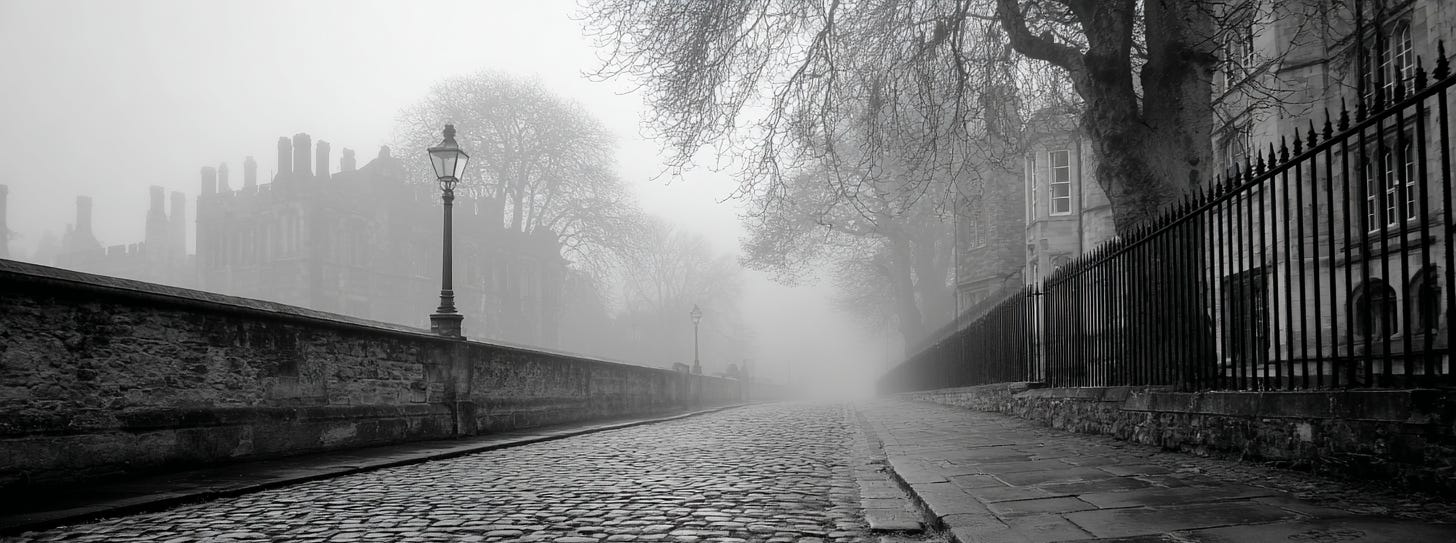
If you pay close attention (which admittedly I only do very rarely), before any endeavor of real significance there’s a silence so complete it almost hums.
It’s the instant between inhale and exhale + movement, before code runs, pen touches page, or a stride begins.
It is pure potential. It exists in time, yet nothing occupies it.
That instant is Zero.
For most of human history, zero was feared.
The Greeks distrusted the void, refusing to name it.
Medieval theologians called it heresy.
Only when mathematicians dared to quantify nothingness did modern science, and with it every algorithm we now run, become possible.
A few years back, as I wandered through Oxford’s stone corridors (shout out to Saïd Business School and St. Hugh’s College), where those same medieval debates once took place, where the idea of “nothing” was literally dangerous, it occurred to me that centuries later, in that same place, I was learning how to build and rebuild from absence: markets, brands, teams, even myself.
The physical architecture hadn’t changed much.
But, importantly for this essay and for my endeavors at large, the mental architecture had, providing permission to question what happens before the number one had.
“Sometimes the void is the first teacher.”
As Charles Seife wrote in Zero: The Biography of a Dangerous Idea,
“Zero is both nothing and everything. It isn’t the absence of value but the capacity for it. Without it, there is no calculus, no physics, no digital world.”
Every equation, every byte of data, begins by acknowledging the void.
In my own life (on my better days, anyway) I’ve come to see Zero not as an erasure but as a foundation.
Each reset after feeling burned out, after a move, after a pivot in business or a change in relationship, isn’t a collapse but a return to ground truth.
Zero is the state before bias, before inertia.
It’s the point where curiosity is still pure, uncolored by outcome.
It’s where everything can begin because it is not “nothing,” yet not quite a “thing.”
“Starting again is a skill, not a failure.”
When I strip away title, ego, or any descriptive facility, what I think remains is rhythm: wake, move, learn, build, grow, break, recover.
The pattern is simple, but the discipline to protect that simplicity is not.
Zero is what remains when you remove noise, financial, metabolic, emotional, or anything that is not literal rhythm.
What’s left isn’t smaller.
It’s pure potential energy waiting to be shaped by intent.
There’s an elegance to beginning from (not quite) nothing.
Architects know it. Every structure starts from the empty plot.
Endurance athletes feel it. Every early morning’s first mile begins with still legs and a steady exhale.
Entrepreneurs live it. Every idea, before it accrues the weight of iteration and complexity, exists as one fragile, feather-light variable: belief.
Zero demands faith in form before form exists.
“You don’t have to see it to build it.”
It’s where I try to return each morning, before screens, before metrics, before caffeine, to re-enter the day clean, leaving the calculus of yesterday behind.
It’s also forgiveness.
To begin again is not weakness but design.
Nature loops through zeros endlessly: seasons, breath, orbit, life, death.
Seife argued that zero changed everything because it let us imagine infinity.
That’s the paradox I love.
The smallest conceptual thing, the one we equate with literal nothing, opens a horizon so large our human brain can’t even fathom it.
Starting from zero doesn’t mean starting over, or starting from nothing.
It means starting from a position of harnessed potential.
Here’s to starting each day, each endeavor, each quest… from zero.
Φ